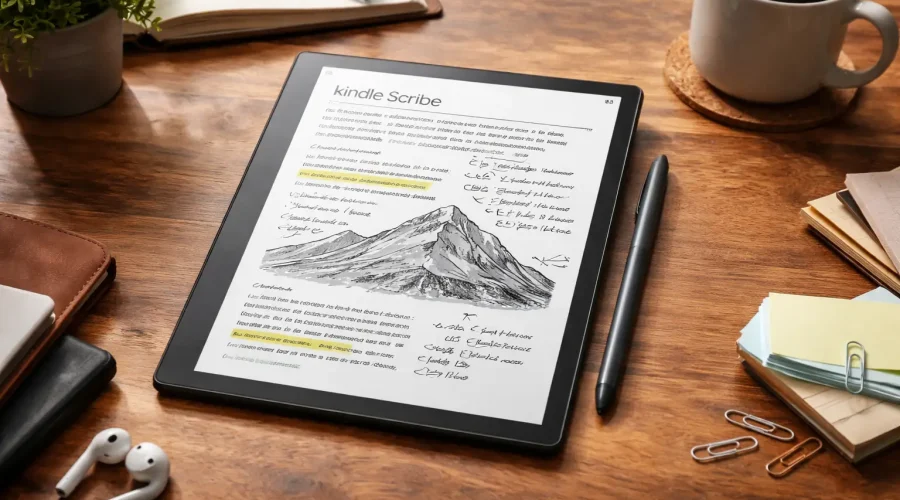

Overview of core capabilities
Kindle Scribe is more than a traditional e-reader. It kindle scribe features a large E Ink display for easy note-taking. Users can annotate, highlight, and organize ideas right in books and documents. The product supports many text formats like AZW3, DOCX, DOC, EPUB, and TXT. It also handles PDFs well, making it great for study materials and professional documents. The colorsoft display adds a unique warmth and a paper-like look, making reading more comfortable during long sessions, especially with the Premium Pen or Basic Pen. The kindle scribe features is an all-in-one device, combining reading, annotation, and note organization, so you won’t need to switch between devices. Our Deep Dive Picks highlight Kindle Scribe features, covering practical workflows, best practices, and advanced tips for readers and note-takers.ures. It covers practical workflows, best practices, and advanced tips for readers and note-takers.
What is kindle scribe features and who should use it?
kindle scribe features is a premium e-reader with advanced notetaking integrated into the Kindle ecosystem. It’s for students who annotate textbooks and PDFs. It helps professionals who write meeting notes and literature reviews. It’s also great for avid readers wanting a smooth reading and note-taking experience. kindle scribe features combines an ink-like display, handwriting input, and flexible export options. This makes it a central hub for reading, annotating, and organizing information.
Notetaking hardware and pen options
kindle scribe features ships with two pen options: the Premium Pen and the Basic Pen. The Premium Pen has a finer nib. It offers high-pressure sensitivity and tilt recognition for brush-like strokes. In contrast, the Basic Pen gives dependable handwriting input for daily tasks. Both pens offer different writing experiences. They include brush types like ballpoint, pencil, marker, and fountain pen styles. You can also adjust the thickness to suit your preference. The colorsoft display with these pens offers natural ink flow and smoother transitions. This creates a more authentic writing experience on the Scribe’s larger screen.
Notebooks, templates, and handwriting options
Notebooks on kindle scribe features offer many templates and formats. You can find blank, ruled, and dotted options. There are also templates for journaling, note-taking, and organizing. Notebook templates affect how notes are taken and found later. It’s useful to match templates with workflows, such as study notes, research logs, or meeting minutes. Handwriting input can be converted to legible text in some scenarios, and users can erase or edit notes directly on the page. The notebook ecosystem helps with long writing, quick notes, and organized study or work sessions.
Highlighting, sticky notes, and anchors to text
One of kindle scribe features is linking notes to highlighted text. This creates context and keeps references tied to the source material. Sticky notes can be added to passages, making it easy to collect quotes, key ideas, or action items without losing the original context. Anchors to text help you organize notes by sections, chapters, or paragraphs. This is useful for literature reviews and research workflows.
Exporting notes, sharing options, and cloud sync
You can export notes from Kindle Scribe features in several formats, like PDF, DOCX, and TXT. This makes it simple to transfer them to cloud storage or share on collaboration platforms. You can send shareable notes and documents by email or cloud services. This helps teams work together on meeting notes, project plans, and annotated PDFs. Cloud sync makes notes available on all devices. This ensures you can easily access them while studying, researching, or working from home. Exporting and sharing notes meets today’s knowledge work needs. It boosts personal productivity and helps teams collaborate better.

How Kindle Scribe features compare across devices and formats
kindle scribe features work well across formats. However, the user experience can change when you compare it to tablets or other e-readers. Some iPad users wonder how Kindle Scribe features stack up against handwritten notes on a touchscreen. They often point out the differences in display tech and how notes are managed. Scribe supports various file formats like PDF, DOCX, and EPUB. This cross-compatibility makes it easy to work with documents created offline or imported from other apps. It ensures flexibility for both students and professionals. The Colorsoft display stands out. It provides a unique reading and writing experience. Many readers like it better than standard grayscale displays on other devices.
Order NowKindle Scribe on iPad vs Kindle Scribe itself
When choosing between the kindle scribe features and an iPad for note-taking, think about these key factors:
- Display
- Battery life
- Reading experience
Kindle Scribe is perfect for long reading. It has an ink-like display and pen input to reduce eye strain. The iPad, on the other hand, provides a wider range of apps and color-accurate displays for multimedia. Both platforms offer sticky notes, highlighting, and annotation. However, Kindle Scribe adds these features directly into kindle scribe features and documents. This creates a smooth reading and writing experience. This can be a big plus for students and researchers who mainly use Kindle.
Colorsoft and display nuances
Colorsoft is a key feature in kindle scribe features. It offers warmer tones and a paper-like look. This helps reduce glare, making it easier to read for long periods. This display quality enhances handwriting input. It makes pen strokes feel more natural on the page. Reading PDFs and eBooks for hours can be tough on your eyes. Colorsoft may provide more comfort and clarity than regular front-lit or backlit screens.
PDF, DOC, and document handling on Scribe
kindle scribe features handles a wide range of document formats beyond the proprietary AZW3, including PDF, DOCX, DOC, EPUB, and TXT. Its versatility helps students and professionals annotate or gather insights from various materials. PDF handling is great for coursework, manuscripts, and technical documents. DOCX and TXT exports make sharing and editing easy in standard office workflows.
Deep dive: Notetaking templates and organization tips
To use kindle scribe features well, choose the right templates and plan your organization clearly. Notetaking templates—blank, ruled, or dotted—help with various thinking tasks. They are great for free-form brainstorming or making structured outlines.
Here are some organization tips:
- Set up a filing system for your notebooks.
- Use tags to categorize your notes.
- Have a strong search strategy to find notes fast.
Templates and tagging help you find information fast. This is useful for literature reviews, study sessions, and work projects.
Notebooks, templates, and handwriting options (detailed)
- Blank notebook: ideal for freehand diagrams, mind maps, and brainstorming.
- Ruled notebook: supports linear note-taking, lecture notes, and meeting minutes.
- Dotted notebook: enables sketching, grids, and precise diagrams.
Pairing notebooks with templates speeds up workflow for students, professionals, and readers. This setup helps with class notes, project planning, and reading annotations. You can choose different ink styles and adjust thickness for clearer notes and better emphasis.
Organizing notebooks for work, study, and research
A solid notebook organization plan groups notebooks by purpose, like work, study, or research. Use tags to sort topics, projects, or courses. A consistent naming convention and use of searchable keywords within notes improve retrieval.
For research workflows, keep separate notebooks for:
- Literature summaries
- Hypotheses
- Data extraction
Use tags to cross-reference and make related notes easy to find.
Using tags, search, and indexing for quick retrieval
Tags are a powerful feature for indexing kindle scribe features content. Apply tags to notebooks, sections, or individual notes to enable rapid filtering and retrieval. Search to find specific phrases, keywords, or mentions in all notebooks. This helps you access information quickly during exams, project reviews, or literature synthesis.
Practical workflows: maximizing productivity with Kindle Scribe
- Meeting notes: capture discussions, decisions, and action items in real time with linked notes and task lists.
- Action item capture: create dedicated task lists or checklists within notebooks, and export as PDF or DOCX for team sharing.
- Literature reviews:
- Annotate PDFs.
- Tag key themes.
- Generate AI-assisted summaries for quick synthesis.
- Journaling and task planning: maintain daily logs and task boards, linking entries to longer-term goals.
These workflows meet the productivity needs of Students, Professionals, and Readers. They show how versatile kindle scribe features is for personal organization and team projects.
Meeting notes and action item capture
kindle scribe features shines in taking meeting notes. It offers structured templates and easy tools for action items. Use anchored highlights to reference decisions, assign responsibilities, and set due dates. Exporting these notes to PDF or DOCX makes it easy to share with teammates. This also helps keep everyone accountable in their workflows.
Research and literature review workflows
kindle scribe features helps researchers with literature reviews. It allows direct PDF annotation, keeps notebooks organized, and offers a tagging system.
- Create separate notebooks for each source.
- Annotate PDFs with quotes and summaries.
- Use search and indexing to build a clear literature map.
Export notes for integration into reference managers or manuscript drafts.
Personal journaling and task planning
Journaling within kindle scribe features helps maintain a reflective practice and steady task progression. Combine daily entries with task lists, and use templates to structure thoughts, goals, and progress. Exporting journaling notes lets you share them selectively. This helps with personal growth and accountability in school and work.
Advanced tips and tricks
- kindle scribe features uses AI to improve handwriting. It also makes short summaries of notebook pages. This helps with quick understanding and easy sharing. You can usually find this feature in notebook menus and AI tools. These tools help summarize or improve content while keeping it easy to read.
- **Keyboard Shortcuts and Stylus Techniques:** Learn pen shortcuts and quick gestures. These help you switch tools, erase, or create new pages quickly. This boosts your speed during lectures or brainstorming sessions.
- AI-powered note refinement and summarization: AI can turn messy handwriting into neat text. It can also create bullet-point summaries for easy review and action items.
AI-powered note refinement and summarization (where available)
AI can now turn messy handwriting into clear script fonts. It can also summarize chosen notebook pages into short bullet points. These kindle scribe features turn handwritten notes into neat, shareable documents. This boosts understanding and teamwork, all while keeping that handwritten touch.
Export formats, sharing options, and collaboration tips
Exports in PDF, DOCX, or TXT formats enable easy sharing and integration with other tools. For collaboration, save notes in cloud storage. Share links with colleagues. This allows everyone to collaborate in real-time or work at their own pace. They can focus on meeting notes, literature reviews, or project plans. Cloud storage and syncing across devices ensure notes stay up to date across work and study environments.
Keyboard shortcuts and stylus techniques for faster ink
Enhance speed and accuracy with keyboard shortcuts and stylus techniques. Shortcuts make common tasks easier. They help you switch tools, create new notes, or search quickly. Also, using a stylus improves your handwriting and navigation in documents. Mastering these techniques speeds up workflows. This is especially helpful for quick note-taking and intense study sessions.
Security, licensing, and legal considerations
- Copyright and Note-Taking Best Practices:
- Respect copyright when you annotate or export content.
- Don’t distribute protected material beyond what is allowed.
- Data privacy and storage matters: Learn how notes are kept in the cloud, what data is gathered, and how it stays safe, especially in organizations.
- Compliance tips for workplaces and schools:
- Follow policies on device use, data handling, and document sharing.
- Use Kindle Scribe according to professional or academic guidelines.
Copyright and note-taking best practices
Always give credit to sources when needed. Don’t copy long proprietary content. Use note-taking for your own study, research, or allowed teamwork. Use a steady workflow that honors intellectual property. This helps with effective annotation and summarization of materials.
Data privacy and storage implications
Cloud syncing and storage bring convenience but also privacy considerations. Check cloud storage terms. Turn on encryption when you can. Also, limit sensitive info in shared notebooks. Grasping these points builds trust and keeps things in line, both personally and professionally.
Compliance considerations for workplaces and schools
Organizations may require specific policies for device use, data retention, and sharing.
Align Kindle Scribe workflows with these policies by:
- Using labeled notebooks
- Setting sharing restrictions
- Documenting data-handling practices
This ensures compliance and secure collaboration.
Troubleshooting common issues
- Recalibrate pen sensitivity if your handwriting feels off. You can also adjust the stroke weight to get a more natural input.
- Sync Issues: If cloud sync is slow or interrupted, do these:
- Check your network connection.
- Re-authenticate your cloud services.
- Verify device permissions.
- **Compatibility Challenges:** When using third-party apps or importing documents, check that the formats are supported. Also, make sure to follow the licensing terms.
Pen sensitivity and calibration problems
Calibrate the pen to restore expected pressure sensitivity and line weight. If handwriting appears inconsistent, recheck the calibration settings and test with multiple templates to normalize input across notebooks.
Sync and cloud errors
Cloud sync problems often stem from connectivity issues or account permissions. Troubleshoot by verifying internet access, signing in to the correct account, and ensuring device settings allow cloud synchronization.
Order NowCompatibility with third-party apps and formats
kindle scribe features supports sending documents via Send to Kindle and importing common formats; however, compatibility with some third-party apps may vary. Check supported formats and licensing terms before importing documents for annotation or sharing.
Conclusion
Kindle Scribe stands out as a versatile device for readers and note-takers, especially when leveraging kindle scribe features like Colorsoft display, pen options (Premium Pen and Basic Pen), and robust export/sharing capabilities. The device’s ability to annotate PDFs, anchor notes to text, and organize notebooks with templates makes it a powerful tool for students, professionals, and casual readers alike. With ongoing updates that expand AI-assisted refinement and summarization, Kindle Scribe continues to evolve as a leading option in digital note-taking for the modern workflow. For users seeking a cohesive reading-and-notetaking experience, kindle scribe features offers a compelling blend of comfort, versatility, and productivity across formats and tools.
FAQS
Can I write directly on books and PDFs?
Yes, write directly on PDFs and many Kindle books using the Premium Pen, with notes that can be anchored to text for context.
How do I export and share notes?
Notes can be exported as PDF, DOCX, or TXT, and shared via email or cloud storage, making collaboration straightforward.